

Changes are coming to the world of Google ads. As of June 30, 2022, you will no longer be able to create or edit expanded text ads. The good news is that pre-existing expanded text ads will run normally and can still be paused or enabled.
Google Ads in a Nutshell
Digital marketing and online advertising are complex but provide businesses with many opportunities to promote their products and services. Google plays a significant role in the success of online ads because it’s continuously launching new features and moving toward automation.
Learning about the difference between expanded text ads and responsive ads can help you improve your digital marketing strategies and enhance your search engine marketing efforts.
What Are Expanded Text Ads?
Expanded text ads are twice the size of regular text ads and are designed to take up more digital real estate on a search engine results page (SERP). These ads improve your online presence and performance with larger headlines and longer descriptions. They’re designed to be responsive, so they will reformat for different devices.
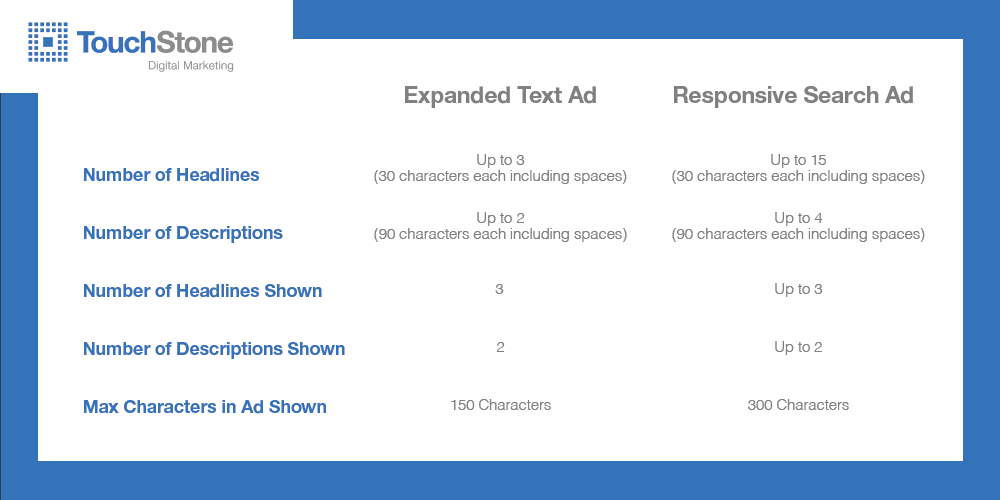
You can include three headlines and two descriptions in expanded text ads. All headlines must be 30 characters or less, and descriptions should be within 90 characters, including spaces.
What Are Responsive Search Ads?
Responsive search ads let you create an adaptable ad to deliver relevant messages to your audience. You can improve your campaign’s performance by building an ad around the search terms and keywords your audience is actively searching.
You can create a maximum of three enabled responsive ads per ad group in Google Ads. Each responsive ad can have up to 15 headlines and four descriptions. However, only three headlines and two descriptions will appear on a SERP. The Google Ads algorithm will continuously test different ad content combinations to determine which ad copy performs best.
Expanded Text Ads Versus Responsive Search Ads
Expanded text ads have preview capabilities, allowing you to see what a completed ad will look like on a SERP. You also have more control over ad appearance because you determine the order of each asset’s position. For example, if you want your company name to appear first, you can place it in the first headline spot.
Here’s an overview of the differences between expanded text ads and responsive ads.
Best Practices When Creating Responsive Search Ads
- Make sure each headline and description make sense as individual assets and can be displayed in any order.
- Create at least one responsive ad per ad group with a “Good” or “Excellent” rating. Improve ad strength by writing unique headlines and adding keywords to headlines and descriptions.
- Use headline sections 1 or 2 and description section 1 for information that must be displayed in your ad. Use pinning to place multiple assets in specific positions.
Benefits of Responsive Ads
Flexibility: Responsive ads adapt to the widths of each device, so your message can be viewed proportionally.
Save time: Google Ads will show your audience the most relevant headline and description combination to encourage engagement and boost performance.
Tailored assets: Headlines and descriptions can be tailored to customer locations or areas of interest.
Relevance: You can create diverse headlines and descriptions for relevance and match user search intent.
The TouchStone team can help you create custom Google ad campaigns to meet your specific digital marketing goals. Contact us online or call 419-299-9000 for more information.